What Is Padel?
The world's fastest growing sport is coming to Charleston, and it's nothing like you've seen before.
Imagine tennis met squash and they had the perfect social sport. That's padel. Played in doubles on an enclosed glass court, it's easy to learn, endlessly social, and seriously addictive. No experience needed—just bring your energy.
A Sport Unlike Any Other
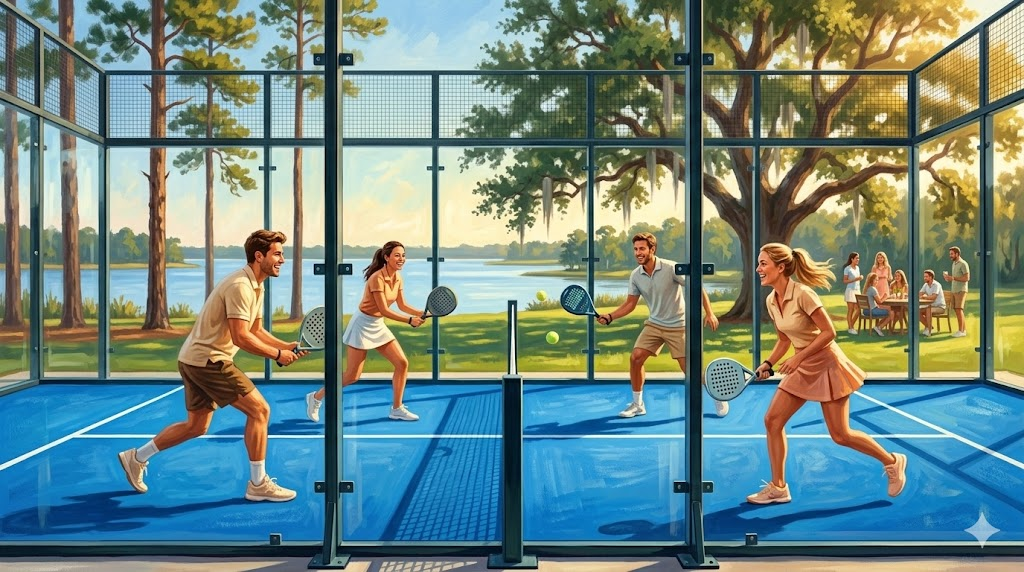
Padel is a high-energy racket sport played in doubles on a 66' x 33' enclosed court with glass walls. Think tennis scoring meets squash walls with non-stop action. The enclosed court means less chasing and more playing—balls bounce off walls to keep rallies alive.
History
Created in Mexico in 1969 by Enrique Corcuera, padel spread to Spain in the 1970s where it exploded in popularity. Spain and Argentina became padel powerhouses, with the sport woven into their social and athletic culture. Today, over 25 million people play worldwide, with professional tours, dedicated facilities, and rapid growth across Europe, Latin America, and now the United States. It's the fastest-growing sport you've probably never heard of—until now.
Quick Facts
- Always played in doubles (4 players per court)
- Smaller than tennis with walls that keep balls in play
- Solid rackets (no strings) and low-pressure balls
- Tennis scoring—easy to follow
- Gentle learning curve—real rallies your first time out
- Social by design—perfect for building connections
The Basics
If you can count to 15, you can score padel.
The Court
The padel court is 66 feet long by 33 feet wide—about a third the size of a tennis court—and enclosed by 10-foot glass walls on the sides and 13-foot wire mesh on the ends. The smaller space means less ground to cover and more focus on strategy over endurance.
The Equipment
Solid rackets (available for rent or purchase) with perforated surfaces instead of strings—shorter than tennis rackets and easier to control. Balls look like tennis balls but have slightly less pressure, making them slower and easier to handle. Court shoes (tennis or running shoes work). That's it.
The Serve
Underhand serves that must bounce once before crossing into the diagonal service box. No overhead power serves. This levels the playing field and keeps focus on strategy.
The Rally
The ball must bounce on the ground first, but after that, walls are fair game. Use your own walls to keep balls in play or strategically use opponents' walls to create difficult returns. This creates incredible rallies with angles and creative shot-making that don't exist in other racket sports.
The Scoring
Exact same scoring as tennis: 15, 30, 40, game. Sets won at 6 games (tiebreak at 6-6). If you've watched tennis, you already understand padel scoring.
The Best Part
You don't need to memorize any of this. You learn by playing. The first time you hit a ball off the back wall to keep a rally alive, you'll get it. Rules become intuitive within minutes.
Why Padel?
What makes this sport so addictive
Easy to Learn
Real rallies your first time out. The enclosed court means less chasing, more playing. Underhand serves remove intimidation. Smaller court means you don't need peak fitness. Immediate gratification keeps you hooked.
Endlessly Social
Doubles format means you're never alone. Constant communication, strategizing, celebrating together. Strangers become friends fast. Post-game drinks happen naturally. This is community, not just competition.
Great Workout Without Feeling Like Work
Fast-paced rallies, quick direction changes, non-stop action. You'll work up a sweat while having fun. An hour flies by because you're strategizing and competing, not watching the clock.
All Ages & Abilities Play Together
Kids to grandparents, beginners to advanced—everyone plays together. Walls are the great equalizer. Strategy beats power. Families can compete genuinely, mixed-skill groups stay balanced.
Strategic & Creative
Rewards thinking players. Use walls for impossible angles. Lob over opponents. Fake directions. Set up your partner. Strategy is endless, and every point is a puzzle. Placement beats power.
Built for Community
Four people on one small court means constant interaction. Talking between points, encouraging partners, complimenting opponents. The format naturally creates connection. People come for the sport, stay for the friendships.
How Padel Compares
| Tennis | Squash | Padel | |
|---|---|---|---|
| Court Size | 78' x 36' | 32' x 21' | 66' x 33' |
| Format | Singles or doubles | Usually singles | Always doubles |
| Walls | None | 4 walls | Glass + wire fencing |
| Racket | Stringed | Stringed | Solid with holes |
| Serve | Overhand | Complex | Underhand (easy) |
| Learning Curve | Steep | Very steep | Gentle |
| Social Factor | Moderate | Low | Very high |
| Physical Demand | High | Very high | Moderate |
Padel takes the best of both—tennis's familiar scoring with squash's dynamic walls—and creates something new. Whether you're a tennis player wanting a fresh challenge or you've never held a racket, padel welcomes you.
Who Plays Padel?
Everyone. Seriously.
Tennis Players
Padel will feel immediately familiar—groundstrokes, volleys, positioning all translate. But walls add new dimensions to strategy. Your tennis instinct works beautifully, and within one session you'll experiment with wall shots and angles. Padel rewards finesse over power, and the doubles format brings more social interaction.
Squash Players
You already understand walls and angles—padel clicks instantly. The larger space and outdoor setting offer different energy. Doubles format brings social elements squash often lacks. If you love strategic wall play but want something more social, padel is your sport.
Social Athletes
Love staying active but hate working out alone? Padel is built for you. Doubles format guarantees you're meeting people. Compact court encourages conversation. Post-game hangouts are mandatory. Fitness, fun, and friendship in one package.
Complete Beginners
Never played a racket sport? Perfect. You'll have real rallies your first time out—no six-week lessons required. Underhand serve is easy. Enclosed court means less chasing. Doubles means a partner helps you learn. And because padel is new to Charleston, everyone's learning together.
Families & Juniors
Enclosed court perfect for kids—balls stay in bounds. Doubles format teaches teamwork naturally. Multi-generational play actually works. Grandparents with grandkids, parents with teens. Walls level the playing field so families compete genuinely.
Corporate Groups
Team-building people actually enjoy. Doubles requires communication and strategy. Learning curve means equal footing quickly. Social nature creates genuine bonding. Unlike golf, you can fit meaningful play into a lunch break. We'll offer corporate packages for culture-building that works.
Fitness Enthusiasts
Full-body workout—lateral movement, direction changes, constant motion. You'll hit cardio and strength through gameplay. But you won't watch the clock because you're strategizing and competing. Functional fitness disguised as recreation. Low-impact compared to running, so play multiple times weekly.
Join Johns Island's Padel Revolution
The Point is now open at Trophy Lakes on Johns Island—Charleston's first dedicated padel facility. Two professional courts, LED lighting, expert instruction, and a welcoming community ready to introduce you to the sport.
Whether you're ready to book a court right now, or you want to explore membership and programming, we'd love to have you be part of this from the beginning.
Johns Island is about to discover what millions worldwide already know: padel isn't just a sport, it's a lifestyle. Book your court today and be part of the movement.